Wednesday, 22 April 2009

Moon Fruit - Online Portfolio

Presently, i am preparing myself for employment this summer after i have completed my first degree in Landscape Architecture at Kingston University. In order to get an employment, i am currently putting together collection of my work that i have achieved in the last 3 years of my degree by creating an online portfolio. Therefore preparing my online portfolio to sell myself to professional landscape practises or companies, to achieve and secure myself with a successful employment.

To achieve my goals, i decided to analyse and identify what the requirements are and the key components of creating an online portfolio on a website host by analysing the past graduate student online portfolio on Moonfruit particularly the most recent year of 2008 at Kingston University for inspiration.

My strongest inspiration was Matt Parker's portfolio: "http://www.mparker.moonfruit.com/"

Matt designed his website in a unique, and simple way but still has a very strong interactive quality.

In terms of this layout, it's very straight forward to understand and easy to navigate through it swiftly without getting confused.

It's very attractive and catches one's attention fully due to its animated qualities.

Although, the overall layout was created using a special program - Adobe Flash. This is a very good method of adding a personal touch to one's portfolio. But Matt Parker's website is quite advanced and technical for my level but i shall still try to achieve this standard if time permits me.

In conclusion, Matt's site has motivated me greatly and also made me to realise the opportunities on how far one can design their own website using moonfruit which can be simply enjoyable.

Other Inspirations:

Both Paul Bratton & Kaori Kishi are very inspiring because they have a very easy and simple layout design. Their portfolio is easy to understand and use by anyone. The graphic quality is plain but still stands out to me.

Links:
Paul Bratton website: http://www.pbratton.moonfruit.com/
Kaori Kishi: http://www.kkishi.moonfruit.com/


Opportunities:

Analysing the overall online portfolio of last year 2008 set, i noticed that majority have a "Black" background and contrasting font colours. I find the use of black background is nice but very dull at the same time and also has a bad effect to the viewers eyes which is not helpful to the users eyes because of this I intend to stay away from using a black background.

Secondly, i observed no-one had a colourful layout too. I believe colours are beautiful but it depends on how one uses them. I intend to have a colourful portfolio because i believe it lightens up the viewers/ users and also i love colours too. This will be my personal touch to my portfolio.

Friday, 17 April 2009

Landscape of Castlefield Urban Heritage Park, Manchester

Castlefield Urban Heritage Park


The Castlefield area has been designated as Britain's first Urban Heritage Park. It represents the wealth of Manchester's industrial heritage which includes its railway viaducts, canal transportation systems and museums. Due to this, it has become a major tourtist hot spot in Manchester, attracting tourist to enjoys waterside experience such as its pleasant walks and boat trips along the Rochdale canal.

Castlefield Outdoor Space


Castlefield has an outdoor space that looks upon the wate's edge of the Castlefield Basin. It is a lovely urban ampitheatre landscaped space that serves an an open theatre in Roman times.


The landscape consist of a permanent canopy thats shadows over 7 pre-cast concrete amphitheatre steps.

Also it has a series of undulating moulds which symbolises waves or flow of water as shown below:


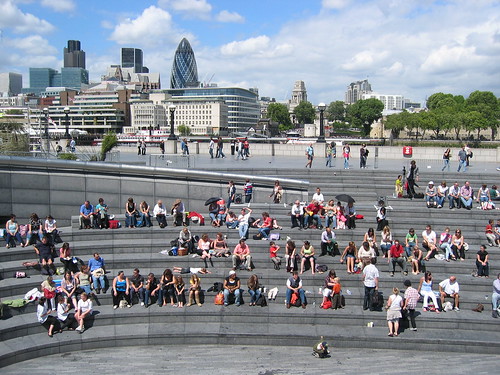
Castlefield landscape design is similar to More London in London and also Sheldon Square in Paddington as shown below; because they all just like a theatre; having the same purposes such as accommodating outdoor events such as exhibitons, plays, etc.

Sheldon Square, Paddington,London

Source:http://lh5.ggpht.com/_ci2iRDwFQaM/RmLO8aJZecI/AAAAAAAAABg/O_0JzQK6IOo/20070602+007.jpg

More London, London

source: http://farm4.static.flickr.com/3168/2624370632_2587abfc9f.jpg?v=0

In conclusion, the landscape is very simple but also represents an elegance of moderen landscape design. My only critism of this site is that it doesn't have any access for a wheel chair user to move freely around the site. If it where to be modified, i will suggest wheel chair access is key, in order to allow wheel chair uses to also have equal spatial experience as the rest of the other people.

More information: http://www.manchester2002-uk.com/castlefield/castlefield1.html

Canal Side Walk Along Rochdale Canal Manachester

I went on the field trip visit to Manchester specifically to look at and observe canals. this is to help me and also to motivate me with my current project I'm working on called the Wey and Arun canal in Surrey.
The Wey and Arun canal is presently undergoing major restoration. The point of going to the Rochdale Canal is to help me understand the infrastructure of how canals are being Incorporated within certain areas and also what makes them attract people to use it.

Rochdale canal
The Rochdale Canal is a 33 miles long canal that lies between Manchester and Sowerby Bridge in West Yorkshire, UK.


Rochdale canal

In Manchester it connects with the Ashton and Bridgewater Canals while in Sowerby Bridge it links both the Calder and Hebble Navigation as shown below:


source: http://www.waterwayroutes.co.uk/images/maps/11_rochdale_580x326.png

Walking along the canal, i observed, the canal runs through an urban environment which was very exciting because the canal side where like a shield away from the noisy busy city. I t was very quiet, relaxing and peaceful.


Built areas around canal

Another thing i noticed is the fact that the canal runs very close to retails areas like shopping malls and cafes. I am positive that the canal experience along the particular part of the canal feels very intimate. It is a shame i wasn't able to go on a boat trip due to the bad weather. The photo below shows a good example of it:


Canal running next to a shopping mall & cafe

Along the canal are beautiful rustic features, for example:

  • The Railway bridge over the canal at Castlefield as shown below is a beautiful infrastructure that has been preserved and maintained its historic context too.

Railway arches over canal

  • An Empty narrow boat feature along the canal: I thought this was very interesting because it has made me to understand the size and scale of a narrow boat. when i look at narrow boats it looks very small but its not as small as we all think it is. Here is a picture to see its spatial composition as shown below:

Empty narrow boat

  • Very old Locks: Locks are the usually found on most canals but in Manchester the old conventional locks are still been maintained.
Locks on Rochdale canal
In conclusion, this has helped me to understand the scale of canals and its also to look at canals in another view. Its amazing the fact that the canal are in the city but while walking along the canal side it still feels like a rural area even the fact that most of the edges are hard and constructed; which i find very interesting. i want to adopt this to my current project giving it both an urban and a rural experience at the same time.

Thursday, 16 April 2009

PHOTOGRAPHY

I attended a lecture on Photography at Kingston University by the head of Photography Dept., Vince Wade. His lecture was about been able to use our cameras either digital or manual to take photos in a different way that captures an interesting perspective of the photo is of and also how to make our photos to have FOCUS.

Vince says ¨taking a photo is not what it is about but what it is of¨

From this lecture i was motivated to strat taking good focus photos of it is of not just about what it is about according to vince.
I gave myself a liitle task to capture light and shadow that totally interpretes the photo in a different way.

Photo one: Capture the rays of light from the lamp post
Looking a tthe photos above; at one glance, it looks like it is foggy outside, but its not..its just the way i have captured the rays light goin through the tree branches.

Photo Two: Capturing of Shadow

The photo above is a beautiful image and i love it. When you look the image above at it looks like i was taking a photo of the tree but instead taking a second look at it, the photo actually captures the most interesting part of the tree's shodow and the rays of light passing through its branches.

With my little task, now i totally believe and agree with Vince Wade's statement ¨taking a photo is not what it is about but what it is of¨

Sunday, 11 January 2009

Rhizotron and Xstrata Treetop walkway @ Kew Garden


Rhizotron and Xstrata Treetop walkway is the latest boardwalk attraction in the Royal Botanic Garden, Kew built around trees.


Picture above how close i got to the tree

It is 18m high and also 200 metre long walkway which has a thrilling and an intimate experience to its environment. Rhizotron and Xstrata Treetop walkway was built to give an insight into ecology of trees.


The protective layer of rust that forms is mottled and is very beautiful which gives it a natural look. Also blending in with the surround landscape of trees without harming it’s sensitive environment.


From the top one gets a beautiful and a unique bird’s-eye view of the whole 300-acre of kew garden (as shown below) and also of London’s skyline.
View from the treetop walkway
It is designed by Marks Barfield Architects, the same architects that designed the London Eye.

It's unfortunate that i visited the treetop walkway in the winter, because all the trees have shed off their leaves. I know that to get the most thrilling experience will be in the summer when the trees have a full canopy and would also be able to see birds nesting etc...


More information:http://www.marksbarfield.com/


Sunday, 4 January 2009

SLA

SLA is an interdisciplinary team in Denmark designing spaces for new urban experiences. Their aim is to transform the spaces of the city into sensuous attractions therefore adding a new layer of meaning to the everyday environment.

Hyllie Station Square , Sweden - 2007
http://www.sla.dk/byrum/hylliegb.htm

They have worked on a significant number of landscape architecture and urban development projects in Denmark and abroad. SLA has been recognised to be the first office to be awarded the Topos European Landscape Award for its focus on sensory urban spaces.

Motalavej (Motala Street), Korsør - 2007
http://www.sla.dk/byrum/motalagb.htm
It’s a small practice that consists of 22 landscape architects. Their work is mainly based on sensorial landscape and urban-space project ranging from big projects such as masterplans to small projects such as installations.

Hornshøj Housing Masterplan, Holstebro,Denmark - 2007


I have a very strong interest for urbanism; I find SLA work exceptionally urban and have a diverse range of interpreting and expressing their concepts.

Kolding Railway Station Plaza, Denmark - 2005

http://www.sla.dk/byrum/koldingb.htm


SLA has a good reputation for student internship which gives students the opportunity to work on the entire field of landscape architecture, planning and urban design.

The Hafencity, Hamburg, Germany - 2003


In order for me to be able to get an internship, certain computer software such as AutoCAD and Adobe skills are required, 3D visualization such as SketchUp are at an advantage for me because I have good experience in using the software very well.

Current Project: Parking in Venice

Location: Piazza Di Laguna / Venezia Ex Locomotive, Venedig
Client: The Municipality of Venice
Design Phase: 2007
Area: 40.000 m²
Details: A complete transformation of the area which consist of construction of a large underground carpark, railway traffic, and the optimizing of traffic connections.

All images: http://www.sla.dk/byrum/venicegb.htm

Organic Waste Management at Kew Garden, London

A talk on compost and waste management by David Barnes, the Manager of Horticultural Support at Kew garden. This is part of fielding Module and its suppose to help me to understand how certain things (wildlife, waste, ect) can be managed.

Kew Garden produces over 100 tonnes of waste plant materials every week. As part of Kew’s commitment to practise sustainable horticulture, they recycle 99% of their organic waste. The method used to manage the organic waste is known as Composting.
Composting at Kew:

Composting organic waste is more environmentally friendly than throwing all the waste in a land fill site.

It’s Advantages:
  • Compost adds more nutrients to the soil, to reduce the use of artificial fertilizers

  • Improves the soils structure so plants grows better and healthy, therefore making them resistant to pest and diseases

  • Compost can be used as mulch on soil surfaces to help retain water

  • Helps to reduce the amount of weeds present
How compost is made?

The sorted materials such as herbaceous and woody trees and shrubs from felled tree branches, etc heaped
  • The woody trees and shrubs from felled tree branches materials are screened and shredded into wood chips
From: Chunks of timber

To: Wood Chips
  • Herbaceous plant materials (leaves & grass clipping) are only shredding.

Heap of leaves and grass clippings

The wood chips are mixed on a ratio of 4:1 with the fresh stable manure, while the shredder herbaceous material is mixed on an equal ratio to the manure.

The mixed shredded materials are stored in heaps as shown below:

Herbaceous plant mixed with manure left to compost

Wood chip mixed with manure left to compost

These heaps are watered with stored rain water and turned regularly to maintain a low temperature. David Barnes said sometimes the temperature of the heaps can rise up to 850C that is high enough to set itself ablaze but the best temperature for the compost process is at 55oC. Therefore allowing micro-organism (bacteria and fungi) to break down the plant materials. The compost process takes about 10 – 12 weeks before it’s been taken back to the garden to be reused as mulch

In conclusion, I believe the waste management at Kew is very effective even though the scheme only started 10 years ago. It’s also very sustainable. It must have saved Kew gardens a lot of millions of pounds. Practising this self-effective method has been beneficial and encouraging to the public. Waste is not easy or simple to control and manage especially in Kew garden when they tend to have a huge number of visitors visiting a year.

The part I find very interesting is the fact that the composting heaps can generate a huge amount of energy on it’s own which is very good but now I’m also questioning why can’t this energy that is been produced be used to generate electricity (thermal energy) or something productive for the garden?

I have learnt so much about waste management and I’m planning to incorporate the method and processes into the management plan report on woodlands.